Diana Spencer
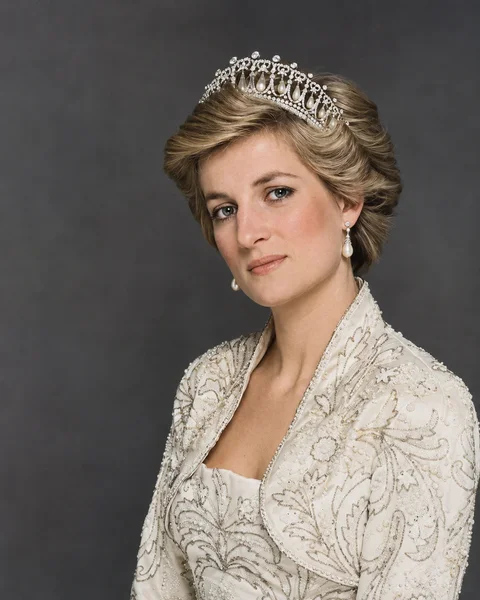
SPENCER Diana Frances, known as Diana, Princess of Wales, was a British public figure who used the attention surrounding the Royal Family to draw support to humanitarian causes. Following her marriage to Prince Charles she became a prominent participant in official public life, but gradually developed an independent role through sustained involvement with charitable organisations.
In September 1982 Diana made her first official overseas appearance alone, representing Queen Elizabeth II at the state funeral of Princess Grace of Monaco. Her first solo overseas tour followed in February 1984, when she travelled to Norway to attend a performance by London City Ballet, of which she was patron. These engagements marked significant early steps in her independent programme of public duties.
Her public role also included ceremonial military appointments in Britain and other Commonwealth countries. In 1985 Diana became Colonel-in-Chief of the Royal Hampshire Regiment and of Canada's Princess of Wales' Own Regiment; she held the latter appointment from 17 August 1985 to 16 July 1996. In 1988 she became Colonel-in-Chief of the Royal Australian Survey Corps, retaining that role until 1996. When the Royal Hampshire Regiment amalgamated with the Queen's Regiment in 1992, Diana became joint Colonel-in-Chief of the new Princess of Wales's Royal Regiment alongside Queen Margrethe II of Denmark. That December she became the first Colonel-in-Chief of the newly formed Light Dragoons. She also served as Honorary Air Commodore of RAF Wittering. These were ceremonial appointments, not military service.
Her contribution to reducing the stigma associated with HIV was particularly significant. In 1987 she opened the Broderip Ward at London's Middlesex Hospital, the first dedicated HIV ward in the United Kingdom. Her willingness to touch patients openly became a widely recognised illustration that ordinary social contact does not transmit the virus. She also supported people experiencing homelessness, children, disabled people and those affected by leprosy. During her marriage she served as president or patron of more than one hundred charities. After her divorce she retained patronages of Centrepoint, English National Ballet, the Leprosy Mission and the National AIDS Trust, together with the presidencies of Great Ormond Street Hospital and the Royal Marsden Hospital.
Diana's charitable work also extended to the Deaf community. She became a patron of the British Deaf Association in 1983 and studied British Sign Language. In August 1990 she used it publicly to address an association conference marking its centenary. Contemporary reporting recorded a notably warm response, reflecting the importance placed on a public figure communicating with Deaf people in their own language.
In the final months of her life, Diana gave particular attention to the human consequences of anti-personnel landmines. During a 1997 visit to Angola, she accompanied HALO Trust staff to a mine-clearance site in Huambo; later that year she visited projects assisting survivors in Bosnia. These visits helped bring the lasting danger to civilians into public view. The international effort to ban landmines involved many organisations and governments: her distinctive contribution was to make its humanitarian urgency more visible to a wider audience.
Diana also directed public interest in her clothing towards charitable fundraising. At Christie's in New York on 25 June 1997, seventy-nine of her dresses were auctioned for more than three million US dollars, with proceeds benefiting the Royal Marsden Hospital Cancer Fund and the AIDS Crisis Trust. Her death in Paris was followed by widespread public mourning and a funeral at Westminster Abbey. Her historical significance lies both in her place within the British monarchy and in her use of public prominence to highlight the experiences of patients, socially vulnerable people and civilians affected by armed conflict.