Jaroslav Benda
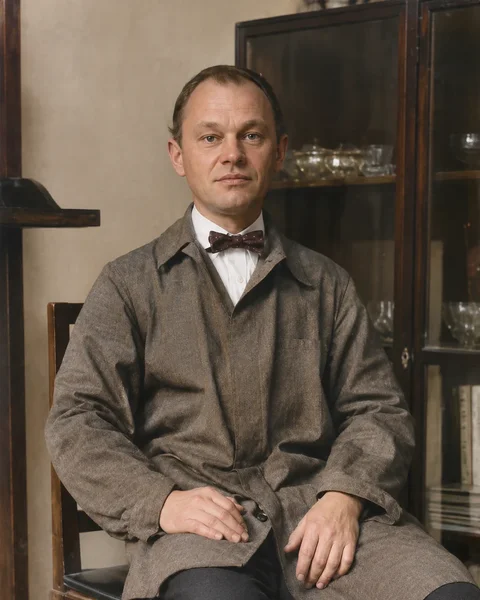
BENDA Jaroslav — a Czech artist, graphic designer, typographer and educator who helped shape twentieth-century Czech book design. His father, Václav Benda, was a metal caster. There were four children in the family, which faced financial hardship because of his father's long-term incapacity for work. Jaroslav spent part of his childhood in Kutná Hora. From 1893 to 1897 he attended the Second Czech Gymnasium in Prague's New Town, then the classical gymnasium in Malá Strana, graduating in 1901. He continued his education at Prague's School of Applied Arts, where he studied under Arnošt Hofbauer, and then at the Academy of Fine Arts. Before his appointment as professor at the School of Applied Arts in 1920, he taught drawing in Prague secondary schools. In 1905 wooden toys made to his designs at the woodworking school in Valašské Meziříčí entered the collections of the Museum of Applied Arts in Brno. That year he also won a prize in a toy-design competition organised by a museum of applied arts. In 1908 Benda helped found the Prague arts and crafts cooperative Artěl, which sought to improve the artistic quality of everyday objects. He designed toys, book endpapers, bindings and decorative glass for the cooperative. Painted glass based on his designs was represented in Artěl's display at the 1925 international exhibition in Paris. From 1907 to 1912 he edited Světozor. He joined the Mánes Association of Fine Artists in 1908, served on its executive committee for thirteen years and as its secretary for seven years. In 1919 he designed the Mánes display typeface, cutting the punches himself. The Prague printing house Grafia produced the type, which was used for an invitation to the 1920 Josef Mánes jubilee exhibitions. Benda also helped develop the exhibition concept and designed one of its lithographic posters. According to the exhibition catalogue held by the Slovak National Gallery library, his works were represented at an exhibition of the Hollar Association of Czech Graphic Artists at the East Slovak Museum in Košice in 1920. With V. H. Brunner and František Kysela, he developed an integrated approach to the book in which lettering, illustration and cover composition served the text. His work included editions of Karel Hynek Mácha and Otakar Březina. In the early 1920s he served on the working committee of the Czechoslovak Werkbund. His graphic works were exhibited at the first Czechoslovak applied arts exhibition organised by the Czechoslovak Werkbund (Svaz československého díla) in Prague in 1921–1922.
He taught for many years at Prague's School of Applied Arts and served twice as rector. In 1920 he took charge of the general school for figure and ornamental drawing and lettering, in 1926 the special school for drawing and painting, and in 1936 the special school for applied graphics, book arts and publicity. His pupils included Antonín Strnadel, Zdeněk Seydl, Jiří Trnka and Jaroslav Šváb, who attended the School of Applied Arts in 1925–1931. Around the turn of the 1940s, Benda developed training for artists in animated filmmaking, contributing to the emergence of Czechoslovak animation. In 1941 the occupation authorities forced him to leave the school. During the occupation he helped pupils facing conscription for labour in Germany find work in an animation studio. After the war he returned to art education and continued his work on film: his archive contains texts for a film about Božena Němcová (1949) and reflections on filmstrips (1950). In 1946–1948 he designed editions of Aristotle's works for the Jan Laichter publishing house, including the Metaphysics, Poetics and Rhetoric. In 1925 he participated in the International Exhibition of Decorative Arts in Paris. Biographical publications credit him with a Grand Prix for book design, although his individual award remains to be verified against the official list of recipients. In 1936 he and architect Ladislav Machoň prepared a competition entry for the Czechoslovak pavilion at the 1937 Paris exhibition. The catalogue of Benda's works records his Grand Prix diploma from that exhibition. His interests extended beyond book design to stained glass, mosaics and applied art. In 1931 he worked on mosaics for the Ministry of Posts in Prague and in 1932 on the mosaic decoration of the technical library in the Clementinum, including the composition Generations Pass on Ideas and the small state coat of arms. In 1935 he designed eight etched glass panels for four windows of the municipal savings bank in Sobotka, with lettering and motifs associated with Masaryk, Havlíček and Rašín. In 1935–1937 he contributed to the decoration of the Comenius mausoleum in Naarden, designed by architect Ladislav Machoň, creating glass panels with inscriptions and dates. Jaroslav Horejc and Karel Štipl also contributed to the interior. The mausoleum was ceremonially inaugurated on 8 May 1937. For his work in Naarden, Benda was made an Officer (fourth grade) of the Dutch Order of Orange-Nassau; the registration card of the Chancellery of the Netherlands Orders records the conferment by Royal Decree No. 155 of 31 December 1937. In 1931 his work Písmo a nápis (Lettering and Inscription), related to his teaching of calligraphy, was published in Berlin. After the 1959 book type competition he continued developing typefaces for typesetting machines. In 1962 he presented Romana & Italka in a printed specimen of Czech and Polish versions; later variants extended the possibilities for setting other languages.
In 1919 he prepared proposals for the Czechoslovak national and presidential flags. His national flag design combined white and red horizontal fields with a vertical blue band at the hoist; this proposal was not adopted as the republic's official flag. In 1920 Czechoslovak postage stamps were issued with his Holubice (Dove) design, featuring a stylised bird carrying a letter in its beak. On the recommendation of sculptor Jan Štursa, Benda received the Czech Academy of Sciences and Arts' annual prize for 1920. Benda also designed the Czechoslovak five-koruna treasury note dated 1921, featuring John Amos Comenius. His collaboration with Otakar Španiel is particularly significant for numismatics. Their joint design under the motto Cimbuří won first prize in the competition for the Czechoslovak gold ducats. The one- and two-ducat designs of 1923 brought the traditional image of Saint Wenceslaus into the visual language of the young republic. In 1929 the same artists extended the series with five- and ten-ducat designs featuring the saint on horseback and a different rendering of the lesser state arms. Benda's co-authorship is documented by the Czech National Bank and the academic biographical dictionary and forms part of his wider contribution to applied graphic design. In 1935 Benda and Španiel jointly designed the chains supporting the academic medals of Masaryk University in Brno; the rector's medal itself was designed by Španiel.
Benda's family life was closely connected with his artistic work. His wife was Marie Wiesenbergerová, and their daughters were Mira (born in 1922) and Jaroslava (Jarka, born in 1923). Jaroslava also worked in graphic design and collaborated with her father on typefaces. In 1965 father and daughter jointly published the ABC 1965 type specimen. In 1969 Jarka Tupá designed the cover and binding of her father's memoirs Léta s umělci (Years with Artists).
Biographical information
Family
Education
Institutional memberships
Employment
Awards and honours
Roles in object creation
Documented roles on specific works; these do not automatically define a profession.
Related objects
1| Images | Relation | DeepCameo object |
|---|---|---|
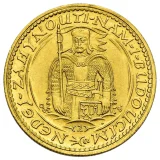  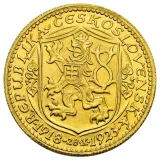  | Designer | Czechoslovak Republic — 1 ducat 1923Numbered jubilee Saint Wenceslas ducat Ducat gold (.986), Reeded edge, Kremnica Mint |