Otakar Španiel
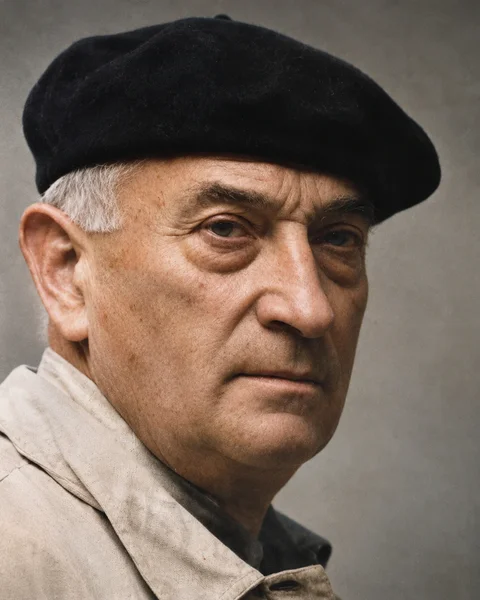
ŠPANIEL Otakar — a Czech sculptor, medallist, carver and educator whose work helped shape the visual identity of Czechoslovak coinage. He trained at the engraving school in Jablonec nad Nisou, studied medal engraving in Vienna under Josef Tautenhayn and sculpture in Prague under Josef Václav Myslbek, and lived and worked in Paris from 1904 to 1912, continuing his training in Alexandre Charpentier's studio. His combination of engraving, sculpture and relief modelling informed his subsequent work.
He became a professor at the Prague School of Applied Arts in 1917 and at the Academy of Fine Arts in 1919, where he developed medallic art. He served twice as rector of the Academy (1937–1939 and 1946–1948). His pupils included Marie Uchytilová-Kučová, Milan Knobloch and Jiří Prádler. He belonged to the Mánes Association of Fine Artists from 1902 to 1949 and chaired it in July–August 1919. His oeuvre included portrait reliefs, busts, monuments and architectural sculpture, among them the western doors of St Vitus Cathedral in Prague. He was imprisoned during the Nazi occupation. In autumn 1942, Španiel and his wife were arrested in connection with the activities of his brother, General Oldřich Španiel, and his son Ivan in the resistance abroad. They were interned at the Svatobořice camp in Moravia as part of the persecution of relatives of resistance members. Former detainee Marie Bednaříková recalled the sculptor making figures out of snow in the camp. According to Olga Mertlíková's biographical study, he was also imprisoned at the Kounic student residence in Brno towards the end of the war. His son Ivan died on the Western Front in 1944 and is commemorated at the family grave in Vyšehrad cemetery.
After the establishment of Czechoslovakia, Španiel contributed to the design of its coins and medals. The artist's correspondence with state authorities, studied by historian Jan Boublík, shows that a shortage of equipment at Kremnica complicated the preparation of the first coins after the First World War. Španiel produced plaster models, including those for the 2-, 5- and 10-heller pieces; delays in the manufacture and acceptance of dies must be distinguished from his modelling work. In the account by Czech National Bank historian Alena Hrdá, Španiel also played a leading role in the design of post-war Czechoslovak coins up to the monetary reform of 1953. With Jaroslav Benda he created the competition-winning Cimbuří design for the Saint Wenceslaus gold ducats. The first issue in 1923 marked the fifth anniversary of the republic. This collaboration united graphic and sculptural approaches to the design of a state trade coin. His death on 15 February 1955 is corroborated by independent museum and municipal sources; the conflicting 12 May date in one museum authority field is inconsistent with that record's own biographical text.
Sport was also a significant theme in his work. For the art competition at the 1912 Stockholm Olympic Games he prepared three bronze plaquettes, although whether they were actually entered remains disputed. In 1933 he created a sculpture of Nike, the goddess of victory, for the Czechoslovak Olympic Committee’s challenge trophy, now known as the Jiří Stanislav Guth-Jarkovský Award. This work was entered in the art competition at the 1936 Berlin Olympic Games.
His early documented commissions include the 1905 medal for the seventieth birthday of Prince Jiří Kristián Lobkowicz. He later designed the medal for recipients of the Leopold Katz Prize, awarded by the Czech Academy of Sciences and Arts for outstanding works of visual art; Max Švabinský was its first laureate in 1931. His work on academic medals connected portrait art with the institutional culture of scientific and artistic honours.
Biographical information
Family
Education
Institutional memberships
Employment
Awards and honours
Roles in object creation
Documented roles on specific works; these do not automatically define a profession.
Related objects
1| Images | Relation | DeepCameo object |
|---|---|---|
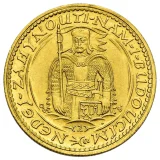  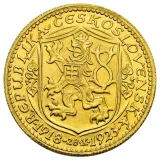  | Designer | Czechoslovak Republic — 1 ducat 1923Numbered jubilee Saint Wenceslas ducat Ducat gold (.986), Reeded edge, Kremnica Mint |