Simón Bolívar
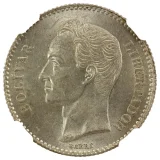
SIMÓN BOLÍVAR (1783–1830) was a South American military and political leader associated with the independence movements against Spanish colonial rule. He is remembered in Venezuela and other countries as El Libertador, “the Liberator.” His portrait on the Venezuelan one-bolívar coin dated 1886 is a posthumous state representation, not an effigy of a ruler reigning in that year.
Born in Caracas on 24 July 1783 into a prosperous Creole family, Bolívar was educated in Venezuela and Europe. He joined the struggle for independence in the early 1810s and received the title Liberator during the campaign of 1813. His military and political career included victories, reversals, exile and renewed campaigns.
In 1819 he helped establish the republic later called Gran Colombia, encompassing territories of present-day Colombia, Venezuela, Ecuador and Panama. The republican victory at Carabobo in 1821 was decisive for Venezuelan independence. In the 1820s Bolívar took part in the campaigns and political reorganisation connected with the independence of Ecuador and Peru; Bolivia was named in his honour. His projects also faced regional conflicts and political disagreement. He died near Santa Marta, in present-day Colombia, on 17 December 1830.
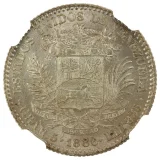
For numismatics, Bolívar's portrait belongs to the history of national remembrance as well as portrait engraving. The Venezuelan silver one-bolívar coin dated 1886 bears his left-facing bust and the legend BOLÍVAR LIBERTADOR. The coin portrait is linked to an earlier die design by the French engraver Désiré-Albert Barre. The depicted person must be distinguished from the separate heraldic representation of the Venezuelan state on the other side.
Biographical information
Related objects
1| Images | Relation | DeepCameo object |
|---|---|---|
    | Depicted | Venezuela — 1 bolívar 1886 Silver 835‰ and copper 165‰ — Venezuela 1 bolívar 1886, Casa de Moneda de Caracas |