Maria Nikolaevna Romanova
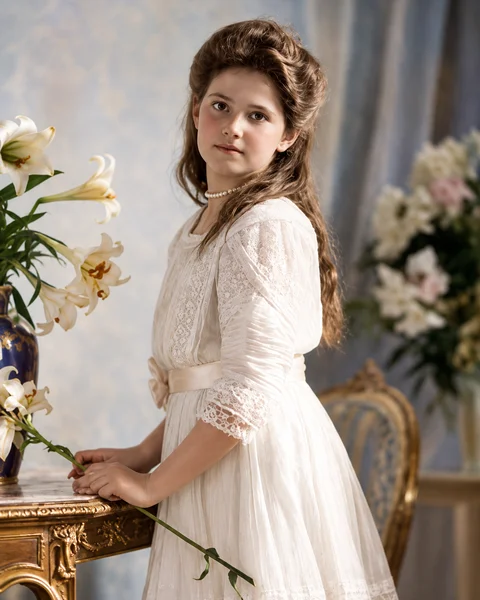
ROMANOVA Maria Nikolaevna — a Russian grand duchess, the third daughter of Emperor Nicholas II and Empress Alexandra Feodorovna. Surviving diaries, letters and photographs illuminate her life not only as part of the tragedy of the last imperial family, but also as an individual experience of upbringing, charitable work and the upheavals of the early twentieth century. Born at Peterhof, Maria grew up mainly at Tsarskoye Selo alongside her sisters Olga, Tatiana and Anastasia and, later, her younger brother Alexei.
Maria received a private education that included foreign languages, history, music and other subjects. According to those who knew the family, she particularly enjoyed drawing, singing and taking part in plays performed at home. Maria and her younger sister Anastasia formed the family's 'little pair', while Olga and Tatiana were called the 'big pair'. Tutors recalled Maria as sociable and attentive to others, although these descriptions reflect the personal impressions of contemporaries. The family's photographic albums preserve scenes of travel to Crimea, walks, games and daily life.
In 1912 Maria became honorary colonel-in-chief of the 9th Kazan Dragoon Regiment. This representative association did not amount to active military service. The First World War changed her daily life. Unlike her mother and her older sisters Olga and Tatiana, who trained as wartime nurses, Maria was too young to undertake formal nursing duties. With Anastasia she prepared dressings, visited wounded soldiers in hospitals, spoke with patients and participated in small performances staged for them. Helping the wounded became a practical commitment rather than merely a courtly duty.
During the February Revolution of 1917, Maria stayed with her mother at the Alexander Palace while her sisters were ill with measles. Memoirs describe her accompanying Alexandra during conversations with troops guarding the residence. Maria herself soon became seriously ill. After Nicholas II abdicated, the family was kept under guard at Tsarskoye Selo and in August was transferred to Tobolsk. Reading, correspondence and ordinary routines continued there, but within increasingly restricted conditions and an uncertain future.
In the spring of 1918 Maria was the first of the children to leave Tobolsk for Yekaterinburg with her parents. Her sisters and Alexei joined them later. The family was held under close guard in the house of the engineer Nikolai Ipatiev, and contact with the outside world was sharply restricted. Witnesses recalled Maria's efforts to converse even with members of the guard. On the night of 16–17 July 1918 she was killed with her parents, brother, sisters and several members of the household.
Maria's papers survive in a separate personal fonds at the State Archive of the Russian Federation. They include diaries from several years, family correspondence, records of charitable activities and documents concerning the Kazan Dragoon Regiment. Forensic investigations of remains discovered in 1991 and 2007 established that none of Nicholas II's children survived the events of July 1918, although researchers have differed over the attribution of particular remains to Maria or Anastasia. In 2000 the Russian Orthodox Church canonised Maria and other members of the family as passion-bearers. These archival materials make it possible to study her life independently of later legends surrounding the fate of the imperial children.
Biographical information
Family
Titles
Awards and honours
Connected through “Calendar”
This person page is an information representation of the existing Person Knowledge and its relations; editorial biography text is not materialized back into Facts.