Alexandra Feodorovna
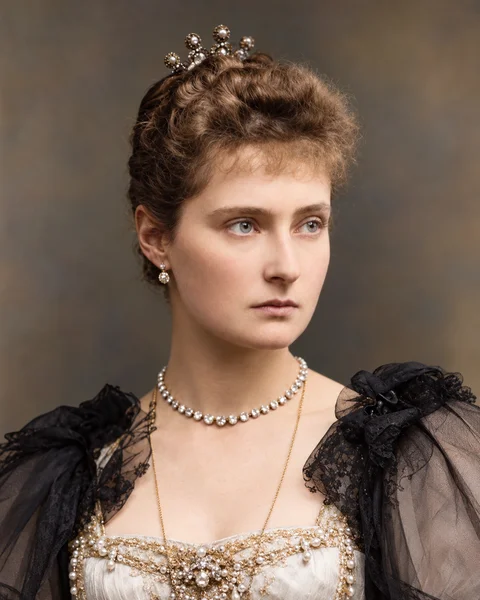
ALEXANDRA FEODOROVNA was Empress consort of Russia, the wife of Nicholas II and the last woman to hold that position in the Russian Empire. Born Princess Alix of Hesse and by Rhine, she belonged to a German ruling dynasty and, through her mother, was a granddaughter of Queen Victoria of the United Kingdom. Her life was closely connected with the final decades of the Russian monarchy, yet her significance is not confined to dynastic events. She supported charitable and medical institutions, and her extensive correspondence provides important evidence for the study of the imperial family and Russian political life in the early twentieth century.
Alix was born in Darmstadt to Louis IV, Grand Duke of Hesse and by Rhine, and Princess Alice of the United Kingdom. Her mother was deeply engaged in the upbringing of her children, nursing and social welfare, setting an example of public service that influenced her daughter. Alice died during a diphtheria outbreak in 1878, when Alix was still a small child. While retaining strong ties with Hesse, she subsequently spent substantial periods in Britain with her grandmother Queen Victoria. She received a private education in languages, literature, music and drawing; her habit of keeping letters and diaries would later make her life unusually well documented. Her elder sister Elisabeth married Grand Duke Sergei Alexandrovich in 1884 and became known in Russia as Grand Duchess Elizabeth Feodorovna.
Alix met the future Nicholas II during visits to Russia. Their attachment developed despite dynastic considerations and a serious religious obstacle: brought up as a Lutheran, Alix did not regard conversion to Russian Orthodoxy as a mere formality. The couple became engaged at Coburg in the spring of 1894. She studied Russian and received instruction in Orthodox Christianity in preparation for marriage. In the autumn, as Emperor Alexander III became gravely ill, she travelled to Livadia in the Crimea. Following his death and Nicholas's accession, Alix was received into the Orthodox Church and took the name Alexandra Feodorovna. The couple married at the Winter Palace on 14 (26) November 1894 and were crowned in Moscow on 14 (26) May 1896.
Alexandra's position at the Russian court was not an easy one. Family life, religious conviction and her partnership with Nicholas occupied a central place in her world, but she found court society difficult to navigate. Her reserve at public functions and dislike of elaborate social occasions were interpreted by some contemporaries as shyness and by others as aloofness. Memoirs and political commentary offer conflicting accounts of her character; such judgements need to be weighed against correspondence and contemporary documents. The couple had four daughters, Olga, Tatiana, Maria and Anastasia, followed by a son, Alexei, the heir to the throne. Alexandra took a close interest in their education, daily routines and health.
Outside the household, charity became one of Alexandra's main fields of activity. She patronised organisations aiding women and children in poverty, vocational workshops, orphanages, nursing communities and maternal and infant welfare institutions. Contemporary records counted thirty-three charitable societies under her patronage by early 1909. Fundraising bazaars and donations provided financial support, and she contributed personal funds to some undertakings. During the Russo-Japanese War of 1904–1905 she promoted the supply of military hospitals, the collection of dressings and other necessities, and the provision of ambulance trains. Her patronage did not mean that she personally performed every task: these institutions depended on doctors, nurses, volunteers and established charitable organisations.
The birth of Alexei in 1904 brought the long-awaited heir, but he was soon found to have haemophilia, an inherited disorder in which a relatively minor injury could cause life-threatening bleeding. His parents tried to keep the condition private, leaving outsiders largely unaware of the anxiety it caused within the family. Alexandra consequently became close to Grigori Rasputin, trusting that his prayers and presence could help relieve her son's suffering. The question of how he affected Alexei's condition, and the extent of his actual influence on state affairs, must be distinguished from the many rumours circulating at the time. Alexandra's reliance on Rasputin nevertheless became a political fact in its own right and contributed to the weakening of confidence in the imperial household.
During the First World War Alexandra devoted considerable attention to wounded servicemen and military families. She supported the establishment of hospitals at Tsarskoye Selo, medical supply arrangements and ambulance trains. With her elder daughters Olga and Tatiana, she undertook wartime nursing training under the surgeon Vera Gedroits and assisted with patient care, dressings and procedures in operating rooms. This was practical medical work, even though her status as empress gave it a public and representative dimension. Charitable committees under her patronage also assisted wounded soldiers, disabled veterans, families of men called up for service and prisoners of war. At the same time the conflict aggravated political tensions. Alexandra's German birth became a pretext for unfounded accusations that she sympathised with Germany or had betrayed Russian interests.
Nicholas's decision in 1915 to take personal command of the armed forces kept him away at military headquarters for long periods, increasing the political importance of the couple's correspondence. Alexandra passed on information, advised him about ministers and appointments, defended autocratic conceptions of sovereignty and sometimes referred to the views of people within her intimate circle. Her interventions in personnel discussions were politically consequential, but they do not substantiate contemporary allegations of espionage or secret direction by foreign powers. Historical assessment requires a distinction between Alexandra's own letters, the decisions actually made by Nicholas II, Rasputin's position and public opinion, as trust in the dynasty declined.
Following the February Revolution of 1917 and Nicholas II's abdication, Alexandra and the children were placed under house arrest at the Alexander Palace at Tsarskoye Selo. The family was transferred to Tobolsk in August. In the spring of 1918 Alexandra travelled with Nicholas and their daughter Maria to Yekaterinburg; the other children joined them later. Their final months were spent under guard and in increasingly severe isolation. During the night of 16–17 July 1918 Alexandra was killed at the Ipatiev House together with her husband, their five children and several members of their household.
In 1998 the remains of Alexandra, Nicholas II and some members of their family were buried in the Peter and Paul Cathedral in Saint Petersburg. In 2000 the Russian Orthodox Church canonised the family as passion-bearers, adding a distinct religious dimension to their subsequent commemoration. Alexandra Feodorovna remains a contested historical figure: her life brings together a family tragedy, religious commitment, substantial charitable and nursing activity, intervention in wartime politics and the crisis of confidence that engulfed the Russian monarchy. Her letters, the records of welfare institutions and the testimony of contemporaries make it possible to examine these aspects separately, without reducing her biography either to an idealised portrait or to an accusatory legend.