Olga Nikolaevna Romanova
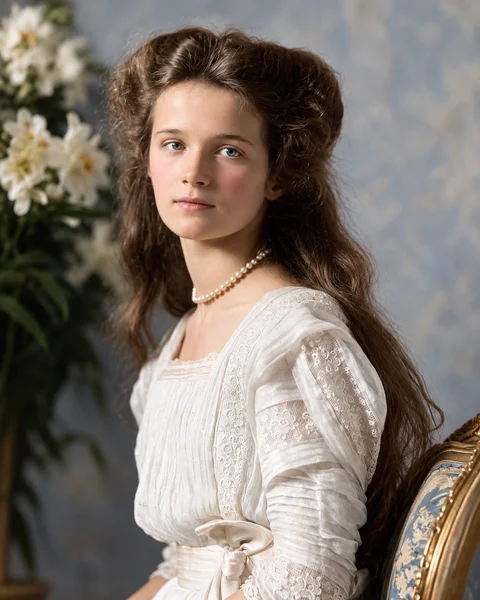
ROMANOVA Olga Nikolaevna — a Russian grand duchess and the eldest daughter of Emperor Nicholas II and Empress Alexandra Feodorovna. Unlike many members of the imperial family who are chiefly remembered through court ceremonies, Olga left a substantial written record. Her diaries, letters and school notebooks make it possible to trace the life of a young woman whose transition into adulthood coincided with a period of upheaval in Russian history. She was born at Tsarskoye Selo and spent much of her childhood with her family at the Alexander Palace.
The daughters were educated privately by tutors, studying languages, history, literature, music and other subjects. Olga developed an early enthusiasm for reading and poetry and kept a diary. Together with her sister Tatiana, she formed the family's 'big pair', while Maria and Anastasia were known as the 'little pair'. Family correspondence and memoirs reveal that the children maintained distinct interests, friendships and concerns even within the relatively sheltered world of the imperial household. Olga was particularly drawn to books and reflection; descriptions of her personality in memoirs should be understood as the individual impressions of contemporaries.
From 1909 Olga held the honorary position of colonel-in-chief of the 3rd Elisavetgrad Hussar Regiment. This was a representative military patronage role, not active service or battlefield command. Regimental reports and correspondence surviving in her personal archive document her honorary connection with the unit. During the First World War, however, her public activities acquired a more immediate and practical purpose.
With her mother and Tatiana, Olga trained as a wartime nurse. She cared for wounded soldiers in hospitals at Tsarskoye Selo, assisted with dressings and participated in the daily routines of a military hospital. Initially assigned to surgical work, she subsequently moved to nursing on the wards because of the strain associated with operations, while continuing to look after patients. Beyond hospital duties, Olga contributed to charitable initiatives supporting servicemen and their families. Documents concerning a relief depot in her name, a Petrograd charitable committee and the hospital at Tsarskoye Selo later formed part of her personal archival collection.
The revolutions of 1917 ended the family's former way of life. Following Nicholas II's abdication, Olga was confined with her parents and siblings at Tsarskoye Selo and then transferred to Tobolsk. In April 1918, when her parents and Maria were taken to Yekaterinburg, Olga remained behind in Tobolsk with the other sisters and her ill younger brother Alexei. As the eldest daughter, she assumed substantial responsibility for the younger children during their parents' absence. In May the remaining family members were taken to Yekaterinburg and confined at the Ipatiev House. On the night of 16–17 July 1918 Olga was killed alongside her parents, brother, sisters and several members of the household.
The State Archive of the Russian Federation preserves Olga's separate personal fonds, comprising 271 archival units, including diaries and notebooks from 1906–1917, family correspondence, photographs, school materials and documents concerning charitable work. These sources allow her life to be studied independently of later legends and fictional treatments of the family's death. In 1998, remains identified by a government commission as belonging to members of the imperial family and their attendants were interred in the Peter and Paul Cathedral in Saint Petersburg. In 2000 the Russian Orthodox Church canonised Olga and other members of the family as passion-bearers. Her diaries remain particularly valuable records of everyday life during war, revolution and captivity.
Biographical information
Family
Titles
Awards and honours
Connected through “Calendar”
This person page is an information representation of the existing Person Knowledge and its relations; editorial biography text is not materialized back into Facts.