Nicholas I
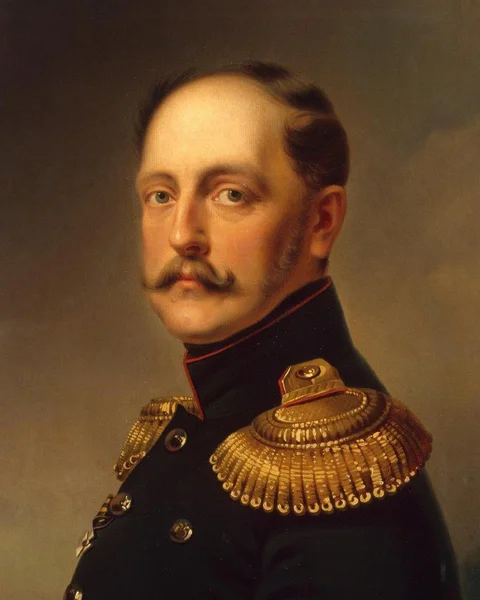
NICHOLAS I was Emperor of Russia from 1825 to 1855, King of Poland and Grand Duke of Finland. The third son of the future Emperor Paul I and Maria Feodorovna, he was a younger brother of Alexander I and Constantine Pavlovich. His reign combined the strengthening of autocratic government and the administrative bureaucracy with the codification of law, expansion of engineering education and transport, and tighter political surveillance. These developments need to be considered together rather than reduced to a simple verdict on the Emperor's personal character.
Nicholas Pavlovich was born at Tsarskoye Selo on 25 June (6 July) 1796. Initially he was not expected to inherit the throne. His education had a pronounced military and technical character, with emphasis on fortification, drafting, construction and military organisation. In 1816 he travelled through Russian provinces and visited Britain. In 1817 he married the Prussian princess Friederike Luise Charlotte Wilhelmine, who entered the Russian Orthodox Church under the name Alexandra Feodorovna. Their seven children were Alexander, later Emperor Alexander II; Maria; Olga; Alexandra; Konstantin; Nicholas; and Michael. The family subsequently formed dynastic connections with several European courts.
Nicholas's accession followed a succession crisis. When Alexander I died in November 1825, an oath of allegiance was initially taken to their brother Constantine Pavlovich, who had previously renounced his claim. The resulting uncertainty ended with Nicholas taking the throne. On 14 (26) December 1825, the Decembrist uprising took place in Saint Petersburg and was suppressed by troops loyal to the new emperor. An investigation and trials followed, with the execution of the revolt's leaders and the imprisonment or exile of other participants. Nicholas and Alexandra were crowned in the Dormition Cathedral of the Moscow Kremlin on 22 August (3 September) 1826.
Nicholas sought to strengthen administrative control and the enforcement of imperial orders. His Own Imperial Majesty's Chancellery became particularly influential; its Third Section served as an agency of political surveillance. The restrictive censorship statute of 1826 became emblematic of the authorities' supervision of public expression, while controls also affected education and universities. At the same time, Nicholas commissioned a major codification of Russian law under Mikhail Speransky. The Complete Collection of Laws and the Digest of Laws of the Russian Empire, compiled and published around 1830–1832, gave officials a more systematic reference framework.
The condition of the peasantry remained a central unresolved issue. Nicholas did not abolish serfdom, although his government introduced limited measures, including Pavel Kiselyov's reform of the administration of state peasants and the decree on obligated peasants in 1842. These changes did not end the dependence of most privately owned serfs. His reign also saw the expansion of military and technical education, administrative institutions and scientific organisations. The Tsarskoye Selo Railway opened in 1837 and the railway between Saint Petersburg and Moscow in 1851. Advances in transport and administration coexisted with estate-based restrictions and political supervision.
Nicholas's foreign policy encompassed wars with Persia and the Ottoman Empire, campaigns in the Caucasus and involvement in European affairs after the revolutions of 1848–1849. The suppression of the Polish uprising of 1830–1831 fundamentally altered the constitutional position of the Kingdom of Poland within the Russian Empire. Russian troops intervened on Austria's side against the Hungarian uprising in 1849. The Crimean War began in 1853 and developed into a conflict between Russia and a coalition including the Ottoman Empire and several European powers. The war exposed serious weaknesses in Russia's military equipment, logistics and administrative capacity.
The emperor's household and court formed an important part of his political and cultural setting. With Alexandra Feodorovna he participated in the dynastic ceremonial life of the empire. Their family is documented in memoirs, portraits, palace ensembles and numismatic works. When interpreting such objects, a direct depiction of Nicholas, a dedication to a person or event, and an indirect historical connection must be assessed separately rather than treated as interchangeable.
Nicholas I died at the Winter Palace in Saint Petersburg on 18 February (2 March) 1855, while the Crimean War was still being fought, and was buried in the Peter and Paul Cathedral. His eldest son succeeded him as Alexander II. The reign's historical legacy includes both the development of particular state institutions and the consolidation of political restrictions, as well as the military and administrative difficulties that helped shape the reforms of the succeeding era.
Names
Biographical information
Family
Titles
Awards and honours
Political functions2
Related objects
2| Images | Relation | DeepCameo object |
|---|---|---|
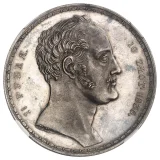  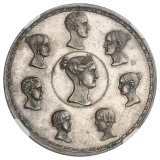  | Depicted | Russian Empire — 1½ roubles — 10 zlotys 18361836 Family Rouble Silver 868/1000, Reeded edge, Saint Petersburg Mint (Russian Empire) |
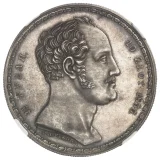  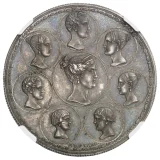  | Depicted | Russian Empire — 1½ roubles — 10 zloty 18351835 Family Rouble Silver 868/1000, Reeded edge, Saint Petersburg Mint (Russian Empire) |