Alexander II
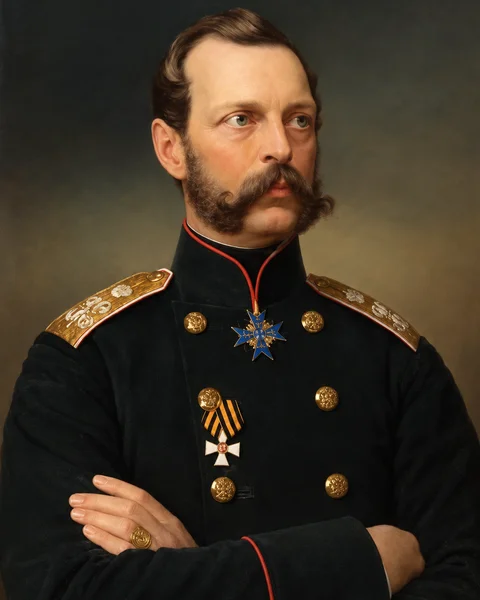
ALEXANDER II was Emperor of the Russian Empire during an era of extensive changes in government and society. His name is associated above all with the emancipation of the serfs, for which he became known as the “Liberator.” Yet his reign combined expanding legal and civic possibilities with the continuation of autocracy, deep social tensions and growing political violence.
Alexander Nikolaevich was prepared for public duty from an early age. The poet Vasily Zhukovsky designed a curriculum intended to combine broad learning with an understanding of a monarch’s responsibilities; his teachers included the statesman Mikhail Speransky. Military training and the influence of Nicholas I formed another part of his education. Journeys through Russia, including Siberia, and across Europe in 1837–1839 acquainted the heir with the empire and the wider continent. Before accession, he acquired experience in senior state institutions and military administration.
His reign began during the closing phase of the Crimean War. The Treaty of Paris of 1856 confirmed an unfavourable outcome for Russia and underlined the need to reform administration, public finances and the armed forces. The central question was serfdom. After prolonged preparation, Alexander approved the Emancipation Manifesto and accompanying legislation on 19 February (3 March) 1861. The legal status of the former serfs was transformed, but land allotments, redemption payments and transitional obligations made the consequences complex and generated dissatisfaction in several parts of society.
Further reforms reshaped other institutions. The Zemstvo Statute of 1864 established elected local-government bodies at district and provincial level, and the Municipal Statute of 1870 reorganised urban administration. The Judicial Statutes of 1864 introduced more open legal proceedings, judicial independence and jury trials, although implementation differed among regions and categories of cases. Changes also affected universities, primary education, the press, public finance and the army; universal military conscription was introduced in 1874. These measures were implemented through the state bureaucracy without replacing autocratic government or removing all distinctions between estates.
Foreign and nationality policies were also complex. The Caucasian War ended during Alexander’s reign, Russian expansion continued in Central Asia, and the Polish uprising of 1863 was suppressed. The Russo-Turkish War of 1877–1878 and the diplomatic settlements that followed altered Russia’s international position and the political order in the Balkans. These developments brought influence as well as conflict and casualties.
The assassination attempt by Dmitry Karakozov in 1866 was followed by other attacks and revolutionary activity, to which the government increasingly responded with restrictive measures. Proposals for further reforms nevertheless continued. In the final years of the reign, Interior Minister Mikhail Loris-Melikov advanced a programme that envisaged limited participation by representatives of society in preparing legislation. The emperor’s approval of proposed preparatory commissions did not amount to the creation of parliamentary government; the programme was not implemented before his death.
On 1 (13) March 1881 Alexander II was mortally wounded by members of the revolutionary organisation Narodnaya Volya beside the Catherine Canal in Saint Petersburg and died at the Winter Palace. Alexander III succeeded him. The Church of the Saviour on Spilled Blood was later built at the site. Alexander II’s historical significance lies not only in the legal abolition of serfdom but also in the long-term consequences of the Great Reforms, the limits of change under autocracy and the unresolved conflicts of his reign.
Names
Biographical information
Family
Titles
Political functions1
Related objects
2| Images | Relation | DeepCameo object |
|---|---|---|
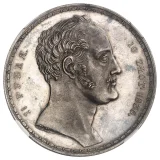  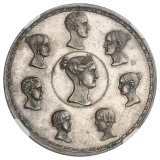  | Depicted | Russian Empire — 1½ roubles — 10 zlotys 18361836 Family Rouble Silver 868/1000, Reeded edge, Saint Petersburg Mint (Russian Empire) |
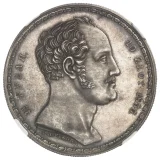  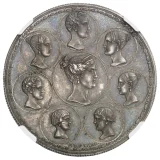  | Depicted | Russian Empire — 1½ roubles — 10 zloty 18351835 Family Rouble Silver 868/1000, Reeded edge, Saint Petersburg Mint (Russian Empire) |