Alexander III
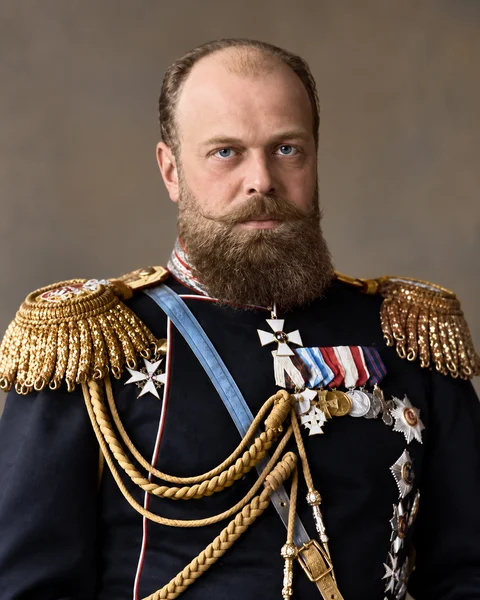
ALEXANDER III was Emperor of the Russian Empire, succeeding Alexander II and preceding Nicholas II. His reign combined the consolidation of autocratic authority and administrative supervision with industrial and railway expansion, changing international alliances and persistent social tensions. He acquired the epithet “Peacemaker” for his policy of avoiding a major European war. The epithet describes one aspect of his historical reputation; it does not imply that his reign was free of armed incidents, repression or conflict.
Alexander Alexandrovich Romanov was born to the heir to the throne, the future Alexander II, and Maria Alexandrovna. As their second son, he was initially educated chiefly for military service, while his elder brother Nicholas Alexandrovich was expected to succeed. Nicholas’s death in 1865 made Alexander heir apparent and prompted further instruction in history, law and public administration. His teachers included the historian Sergei Solovyov, the philologist Yakov Grot and the legal scholar Konstantin Pobedonostsev. Pobedonostsev subsequently exerted considerable influence on Alexander’s views of autocracy, the Church and the limits of political reform.
In 1866 Alexander married Princess Dagmar of Denmark, who had been engaged to his late elder brother. On entering the Orthodox Church she took the name Maria Feodorovna. The couple had six children: Nicholas, Alexander, George, Xenia, Michael and Olga; their son Alexander died in infancy. Family life and correspondence with relatives occupied a prominent place in their lives. The marriage also connected the Russian imperial family to the Danish royal house and other European dynasties.
Before becoming emperor Alexander held military and state appointments and participated in the State Council and Committee of Ministers. During the Russo-Turkish War of 1877–1878 he commanded the Ruschuk detachment in Bulgaria. In recognition of his command, on 26 February (10 March) 1878 he was presented with a gold sabre set with diamonds and bearing a personalised inscription for his distinguished leadership of the detachment. After the war he assisted in establishing the Volunteer Fleet. These responsibilities gave him experience in military command and government without making him an advocate of parliamentary representation.
Alexander III succeeded to the throne after members of Narodnaya Volya assassinated his father on 1 (13) March 1881. Amid discussions of Mikhail Loris-Melikov’s proposals for limited participation by representatives of society in legislative preparation, the new ruler chose to maintain unrestricted monarchical authority. The Manifesto of 29 April (11 May) 1881 affirming the inviolability of autocracy marked this direction. Alexander III and Maria Feodorovna were crowned in Moscow on 15 (27) May 1883.
Domestic policy combined restrictive administrative measures with selected social and economic initiatives. The 1881 security regulations enlarged the emergency powers of local authorities. Press regulations in 1882 strengthened censorship, and the University Statute of 1884 curtailed institutional autonomy. The establishment of land captains in 1889 and the zemstvo and municipal regulations of 1890 and 1892 increased state supervision of local self-government while narrowing electoral participation. Historians commonly discuss these measures as part of the ‘counter-reforms’.
Imperial policy toward national and religious communities also became more restrictive. Measures promoting linguistic and administrative uniformity intensified in several regions. The Temporary Rules of 1882 imposed further restrictions on Jews within the Pale of Settlement, and later regulations limited access to educational institutions. These policies affected not merely official administration but the legal status and daily lives of imperial subjects.
At the same time, the government reduced peasants’ redemption payments, established the Peasant Land Bank, developed factory inspection and gradually abolished the poll tax. Legislation began regulating aspects of industrial employment, including child labour. The finance ministers Nikolai Bunge, Ivan Vyshnegradsky and Sergei Witte pursued different policies to strengthen public finance, support industry, protect domestic production through tariffs and expand railways. Construction of the Trans-Siberian Railway began in 1891. Economic growth was uneven and accompanied by serious pressures in rural and industrial communities.
The crop failure and food crisis of 1891–1892 brought severe hardship to large parts of European Russia. Government agencies, zemstvos, civic organisations and private individuals organised relief, but the scale of the emergency exposed weaknesses in existing food-security arrangements. Epidemics, including cholera in 1892, compounded the crisis. These events form an essential counterweight to measures of industrial expansion when assessing conditions in the empire.
In foreign affairs Alexander III sought to keep Russia out of a major European war while defending its imperial interests. Relations with Germany and Austria-Hungary gradually became more strained, particularly over Balkan affairs. Political and military rapprochement with France developed toward the end of the reign and was formalised in agreements reached between 1891 and 1893. Avoidance of a major war between European powers did not mean that armed incidents ceased on the empire’s frontiers or that coercive methods disappeared from domestic government.
In October 1888 the imperial family survived the derailment of their train near Borki. The incident attracted considerable contemporary attention and later produced legends that should be distinguished from documented testimony. Alexander suffered serious illness in his final years and died at Livadia Palace in Crimea on 20 October (1 November) 1894. He was buried in the Peter and Paul Cathedral in Saint Petersburg and succeeded by his eldest son, Nicholas II.
Alexander III was interested in history and painting, collected Russian art and supported artistic initiatives. His collection contributed to the nucleus of what became the Russian Museum. The State Russian Museum of Emperor Alexander III was established in Saint Petersburg after his death, in 1895, and opened to the public in 1898. The distinction between the ruler’s personal collecting and the later establishment of the museum matters for understanding collection history and the provenance of its objects.
Alexander III’s reign produced a substantial material and artistic record: state coinage bearing his portrait, coronation and commemorative medals, jetons, portraits and objects associated with imperial ceremonies. In attributing such objects, a depiction of the ruler, his monogram, an event commemorating him and an item merely dated to his reign must be distinguished. His historical significance cannot be reduced to either the label ‘Peacemaker’ or ‘counter-reformer’; it lies in the interaction of political choices, economic change, imperial restrictions and their long-term consequences for Russian society.