Maria Feodorovna
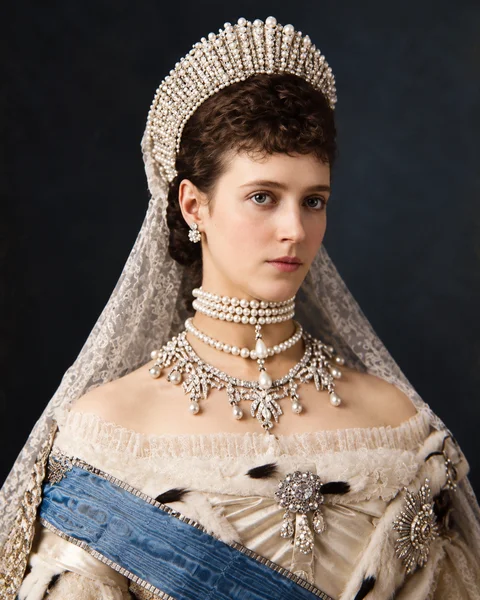
MARIA FEODOROVNA (born Princess Dagmar of Denmark) was Empress consort of Russia, the wife of Alexander III, the mother of Nicholas II and a major patron and organiser of charitable activity in the late nineteenth and early twentieth centuries. She must be distinguished from an earlier Empress Maria Feodorovna, the wife of Paul I, whose name was also attached to Russian welfare institutions. The later Maria's public work encompassed orphanages, education for girls, nursing, the Russian Red Cross and lifesaving services. Her life linked the Danish royal family to the Russian imperial dynasty and extended through war, revolution and exile.
She was born on 26 November 1847 at the Yellow Mansion in Copenhagen and named Marie Sophie Frederikke Dagmar. Her father, Prince Christian of Schleswig-Holstein-Sonderburg-Glücksburg, became King Christian IX of Denmark in 1863; her mother was Louise of Hesse-Kassel. They raised six children in a household which, while royal, placed considerable emphasis on family life and personal education. The children's marriages later connected Denmark to the ruling families of Britain, Russia and Greece. Dagmar's sister Alexandra married the future Edward VII of Britain, while her brother William became King George I of Greece. Dagmar maintained close emotional ties to Denmark throughout her life.
Her first engagement, in 1864, was to Tsesarevich Nicholas Alexandrovich, the eldest son of Emperor Alexander II and heir to the Russian throne. The proposed marriage had an important dynastic dimension, but the young heir died in Nice in April 1865. His death brought personal grief to Dagmar and the imperial family. In the following year she became engaged to his younger brother Alexander Alexandrovich, who had become heir apparent. Dagmar travelled to Russia in the autumn of 1866, was received into the Orthodox Church under the name Maria Feodorovna and married Alexander. As his wife she was Tsesarevna and Grand Duchess. Contemporaries often praised her outgoing manner, but settling into the customs, language and formal obligations of the Russian court required sustained adjustment.
Maria and Alexander had six children: Nicholas, the future Nicholas II; Alexander; George; Xenia; Michael; and Olga. Their second son Alexander died in infancy, while George died as a young man in 1899. Family life occupied an important place in the couple's letters and in the recollections of their children. Maria was closely involved in their upbringing, health and daily activities, and the family sustained regular contact with Danish relatives through correspondence and visits. The surviving record gives a view of personal affection, anxieties and disagreements that cannot be recovered from formal royal portraits alone.
Maria Feodorovna's charitable activity began before her husband became emperor. During the Russo-Turkish War of 1877–1878 she helped organise assistance to sick and wounded soldiers, supporting the collection of dressings and other supplies, hospital provision, ambulance trains and nursing work. On 24 April 1878, according to the Julian calendar used in imperial Russia, she was awarded the Red Cross Badge of Distinction, First Class, for her care for wounded servicemen. Her contribution went beyond ceremonial endorsement, although the actual medical work depended on physicians, nurses and professional welfare organisations. The Russian Red Cross became one of the principal institutions with which her name was associated, serving military hospitals, training caregivers and organising relief during emergencies.
In 1880 Maria assumed leadership of the Department of Institutions of Empress Maria, an extensive network of educational and welfare establishments originally associated with the earlier Empress Maria Feodorovna, wife of Paul I. Following the assassination of Alexander II in March 1881, her husband succeeded to the throne as Alexander III and Maria became Empress consort. She continued supervising work connected with orphanages, foundling homes, almshouses and schools. Administrative reforms under her patronage sought to improve children's care and attract private charitable funds. Girls' education received particular attention, including the Mariinsky schools, which combined general instruction with vocational skills. She also supported the Society for Rescue on the Waters, which maintained rescue stations and equipment for people in danger on rivers and at sea.
Alexander III died at Livadia in 1894, leaving Maria Feodorovna the Dowager Empress and their eldest son Nicholas II the new emperor. Widowhood and a generational change at court altered her public position but did not end her work. During the Russo-Japanese War of 1904–1905 she encouraged the establishment and supply of ambulance trains, the collection of medicines and clothing, and fundraising for soldiers' medical needs. Letters from wounded men and administrative records make it possible to follow these efforts beyond public ceremony. During the First World War, despite advancing age, Maria continued visiting hospitals and supply depots, receiving medical detachments and supporting prisoners of war and the work of the Red Cross. Much of her work during the empire's final years took place in Kyiv.
Maria retained her own views about monarchy and Russia's political direction. Her correspondence with Nicholas II and other relatives reveals both affection and disagreements, and memoirs provide sometimes conflicting accounts of her relationships with Alexandra Feodorovna and other members of the family. Such testimony requires a distinction between recorded actions and later speculation about personal influence. The February Revolution of 1917 and Nicholas's abdication ended the imperial family's former position. Maria later went to Crimea as the civil war spread. The murder of Nicholas II and his family, and the killing of her son Michael in 1918, were devastating blows.
In April 1919 Maria Feodorovna left Russia on the British battleship HMS Marlborough, which evacuated members of the former imperial family and other refugees from Crimea. After a period in Britain she returned to Denmark and settled at Hvidøre, a villa near Klampenborg. There she supported Russian refugees and maintained correspondence with relatives and acquaintances dispersed across Europe. She died on 13 October 1928. Her first burial was at Roskilde Cathedral, the traditional burial place of Danish monarchs. In September 2006 her remains were transferred to Saint Petersburg and reinterred in the Peter and Paul Cathedral beside Alexander III.
Maria Feodorovna's historical significance extends beyond dynasty and the tragedy of the last Romanovs. Over decades of patronage, institutions caring for children, women, the wounded and people living in poverty developed and expanded. These achievements depended on substantial staffs, public and private funding, and the administrative arrangements of their period; they were not the work of a single individual. Her private correspondence, archival records and the surviving documentation of charitable bodies together offer evidence for both the intimate history of the imperial household and the wider development of organised welfare in Russia.
Names
Biographical information
Family
Louise of Hesse-Kassel