Igor Vasilyevich Kurchatov
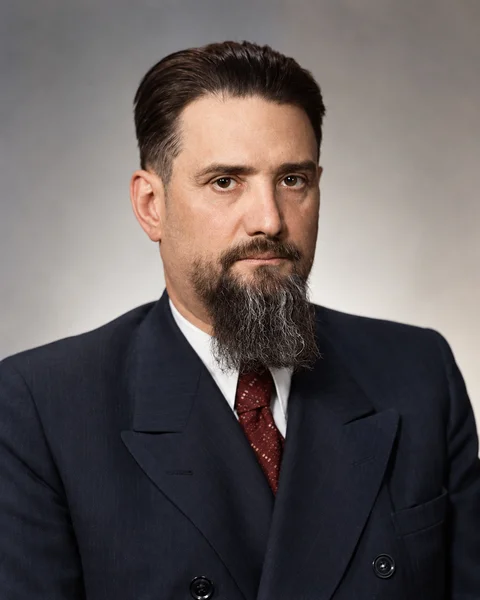
KURCHATOV Igor Vasilyevich — a Soviet experimental physicist and organiser of science whose career connected research into the electrical properties of matter with the emergence of nuclear physics and the development of the Soviet atomic programme. His scientific path began long before the atomic project. While growing up in Crimea, he combined secondary education with training in metalworking and employment at a small mechanical workshop. After graduating from Taurida University, he worked in several research and teaching positions before joining the circle of Abram Ioffe at the Leningrad Physico-Technical Institute.
Kurchatov initially studied dielectrics and semiconductors. His work with Pavel Kobeko contributed to the understanding of ferroelectricity, the behaviour of materials capable of changing their electrical polarisation in response to an external field. During the first half of the 1930s, he increasingly turned to the atomic nucleus. A research group developed around him, investigating neutrons, nuclear reactions and particle accelerators. In 1940, Georgy Flyorov and Konstantin Petrzhak observed the spontaneous fission of uranium in research conducted within the scientific environment that Kurchatov had helped establish. He also organised conferences in nuclear physics, bringing findings from different laboratories into wider scientific discussion.
The Second World War redirected his work towards urgent practical problems. Together with Anatoly Alexandrov and other specialists, Kurchatov helped develop methods of demagnetising naval vessels to protect them from magnetic mines. Scientific findings had to be translated into reliable engineering procedures for use by the navy. Experience coordinating researchers, engineers and military personnel would later prove important on a much larger scale.
In 1943, Kurchatov took charge of Laboratory No. 2 of the USSR Academy of Sciences, which became the scientific centre of the country's effort to harness nuclear fission. Directing the atomic project required coordination across neutron physics, isotope separation, materials production, reactor construction and engineering design. The results were necessarily collective achievements involving many physicists, chemists, engineers and industrial workers. On 25 December 1946, the experimental F-1 reactor in Moscow achieved the first controlled nuclear chain reaction in the Soviet Union. In August 1949, the country's first nuclear explosive device, RDS-1, was tested. Kurchatov subsequently helped direct research on thermonuclear weapons, including major tests during the 1950s.
At the same time, he promoted the use of nuclear energy beyond military applications. Research teams developed under his leadership contributed to the first nuclear power station at Obninsk, which began supplying electricity to the grid in 1954. Working with Alexandrov, he helped shape programmes for nuclear power in electricity generation and transport. He also supported the establishment of new research centres and the training of specialists, recognising that nuclear science could no longer develop within a single laboratory.
One of the most significant episodes of his later career was a lecture given at the British atomic research establishment at Harwell in 1956. By presenting Soviet results in controlled thermonuclear fusion, Kurchatov helped encourage international scientific exchange in a field that had previously developed largely under secrecy. The episode illustrates the complex historical setting of his work: scientific achievements made during the nuclear confrontation also created opportunities for peaceful research and cooperation.
Kurchatov's legacy extends beyond the facilities constructed and the results achieved under his scientific direction. It includes the development of research schools, enduring scientific communities and institutions that helped establish nuclear physics as a major field of science and technology.
Biographical information
Family
Education
Employment
Awards and honours
Related objects
1| Images | Relation | DeepCameo object |
|---|---|---|
    | Commemorated · About · Depicted | Russian Federation — 3 roubles 202380th Anniversary of the NRC Kurchatov Institute and 120th Birth Anniversaries of Academicians Kurchatov and Alexandrov Silver 925/1000 — Proof, SPMD |
This person page is an information representation of the existing Person Knowledge and its relations; editorial biography text is not materialized back into Facts.